
SEO vs AEO: What’s the Difference?
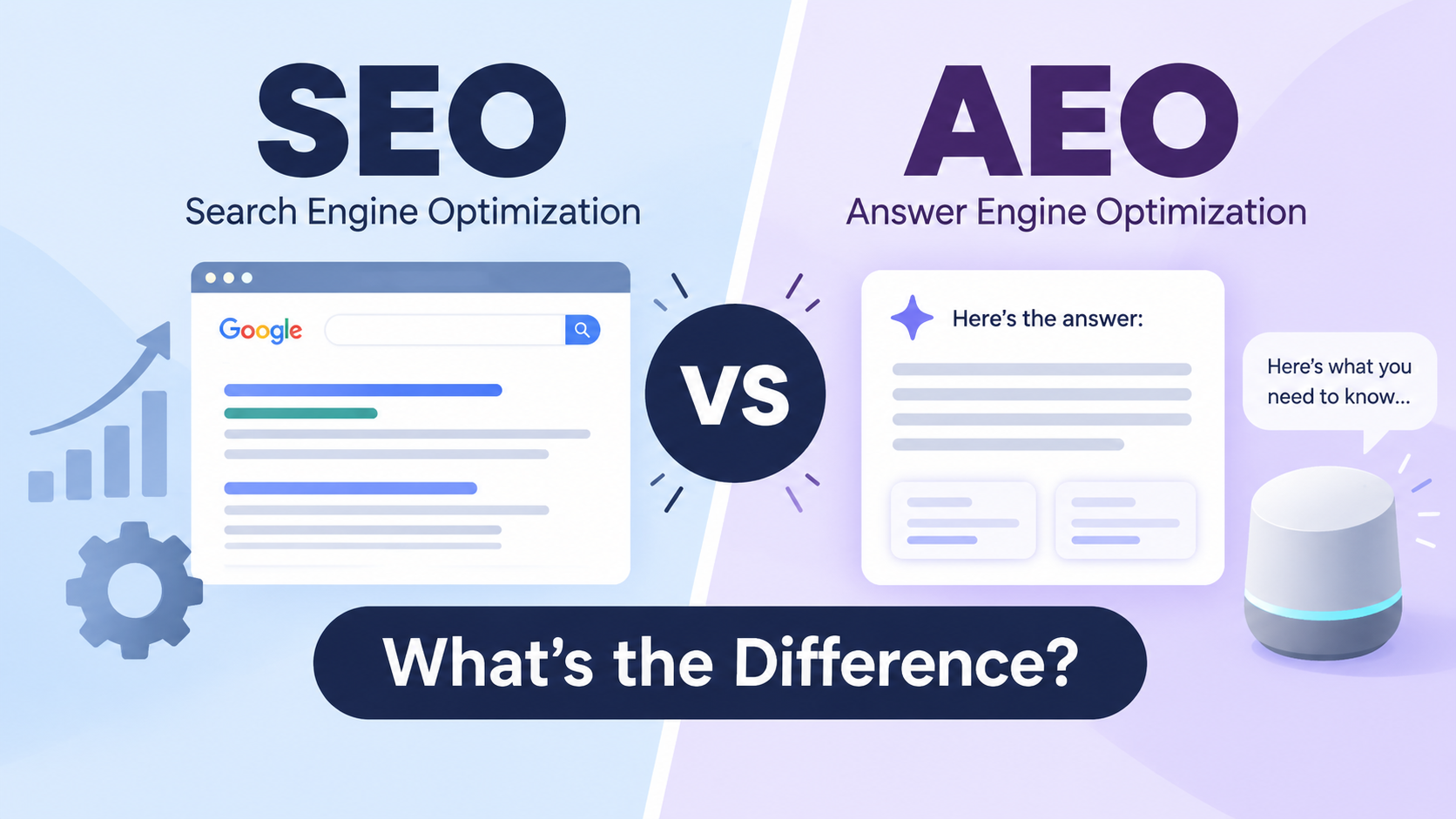
Information search and discovery online is experiencing a dramatic transformation. For years, digital marketing strategies focused almost solely on traditional Search Engine Optimization (SEO), optimising websites to rank on page one of Google's "blue links." While keeping strong organic SEO rankings remains integral for visibility purposes, another key player - Answer Engine Optimization (AEO) has dramatically transformed this space.
Today's users are increasingly opting out of traditional search results entirely and instead turn to conversational AI platforms like ChatGPT, Perplexity and Google's AI Overviews for instantaneous answers. A successful digital strategy must address both traditional search crawlers and large language models (LLMs) powering zero-click answer engines as ways of staying visible for consumers.
This comprehensive guide deconstructs both SEO and AEO into actionable strategies designed to assist with traditional discovery as well as AI-powered recommendations.
Table of Contents
- What is Search Engine Optimization (SEO)?
- What is Answer Engine Optimization (AEO)?
- The Main Differences Between SEO and AEO
- Why Traditional Search Strategy Must Evolve
- Step-by-Step: How to Implement SEO
- Step-by-Step: How to Implement AEO
- Measuring Success: Metrics for SEO & AEO
- The Future of Search: Can SEO and AEO Coexist?
1. What is Search Engine Optimization (SEO)?
Search Engine Optimization, also known as SEO, refers to the practice of increasing website traffic through organic search results. SEO involves technical updates, content production and backlink building.
Doing SEO typically means seeking ways to increase a site's authority so it appears in search engine results pages, with users clicking through and visiting a client website - success measured through impressions, clicks and eventual conversion rates on site.
SEO is built upon discovery. A user enters their query such as, "plumber near me" or "how to fix a leaky faucet", selects from an options list provided by search engines and makes their selection from this selection list. Search engines serve as librarians pointing them towards books which best address their need; today however many users only want one page that addresses their immediate issue immediately and not reading through multiple books before finding what they're searching for.
2.
What is Answer Engine Optimization (AEO)?
Answer Engine Optimization is a relatively new subfield of digital marketing that involves optimizing content so AI engines and voice assistants provide direct answers to users queries instead of returning links; an answer engine like ChatGPT or Perplexity synthesize information directly and give one concise response instead.
AEO requires taking an alternative approach to content structure reliant heavily on structured data, clear facts and high brand authority; AI models don't browse websites like humans; instead they ingest data in an automated fashion before searching out what response would provide the greatest consensus and authority response to prompts.
3.
The Main Differences Between SEO and AEO
While they share a common goal of visibility, the mechanics differ. SEO focuses on broad topics, keywords, and site-wide authority. AEO focuses on specific questions, intent, and concise data.
- User Intent: SEO often targets browsing intent. Users want to compare options. AEO targets solving intent. Users want a specific fact or a direct recommendation.
- Content Length: SEO typically rewards long-form, detailed content that covers a topic extensively. AEO rewards clear, punchy, and factual snippets that an AI can easily parse.
- Structure: SEO relies on headers and internal linking. AEO relies on schema markup and Q&A formats.
- Success Metrics: SEO looks at Click-Through Rate (CTR). AEO looks at brand mentions and being the cited source in an AI response.
How does this affect you? You need to look at how information is formatted just as much as what the information says.
4.
Why Traditional Search Strategy Must Evolve
How users find information on the web has undergone significant changes over the years. In the early days, users would have to do multiple searches, open multiple sites on different tabs in order to find the information they were looking for. However today users expect to find answers quicker - in as little as one search query. This is where AI excels, it provides a "virtual assistant" that does the research for you and answers your question right away.
If your agency is still focusing on keyword optimization, it could be falling behind. As AI takes over as the primary search behavior, SEO needs to evolve in order to stay relevant.
5.
Step-by-Step: How to Implement SEO
To maintain a robust foundation for organic search traffic, your SEO strategy must prioritize authority and technical health.
Step 1: Intent-Driven Keyword Research
Move away from raw search volume metrics and focus on search intent mapping. Categorize your target keywords into informational, navigational, commercial, and transactional buckets. Build content clusters that thoroughly answer the broad thematic concepts your audience cares about.
Step 2: Establish Topic Clusters and Content Pillars
Create a single, authoritative "pillar page" that covers a core topic broadly. Then, author multiple supporting sub-topic articles that dive deep into specific long-tail keywords. Link all sub-topic pages back to the main pillar page to signal strong topical authority to search engines.
Step 3: Optimize Technical Health
Ensure your technical foundation is solid:
- Maintain Core Web Vitals scores in the "Good" threshold by optimizing images and leveraging browser caching.
- Enforce clean, logical URL structures.
- Ensure full mobile responsiveness, as search engines utilize mobile-first indexing models.
Step 4: Secure High-Value Backlinks
Focus on earning links from highly trusted, topically relevant domains within your industry. Use strategic guest posting, original data reports, and digital PR campaigns to build an organic, authoritative backlink profile that signals domain trustworthiness to search crawlers.
6.
Step-by-Step: How to Implement AEO
Optimizing for answer engines requires transitioning from generalized writing to structured data delivery.
Step 1: Implement Comprehensive Schema Markup
Schema markup acts as a direct translator for AI models. Deploy advanced
JSON-LD schema across your entire site. Do not limit this to basic Article schema; use specific schemas such as:
- FAQPage schema for question-and-answer assets.
- Product and Review schema to clearly declare costs, ratings, and specifications.
- Organization or LocalBusiness schema to establish clear entity details.
Step 2: Adopt a Conversational Q&A Format
AI engines process semantic, natural language queries. Structure your content to explicitly state the exact question as a heading, followed immediately by a direct, concise answer.
Step 3: Optimize for "Entity-Based" Search
AI engines operate on Knowledge Graphs - systems that understand the relationships between real-world entities (people, places, things, concepts). To align with this, clearly define your brand's unique attributes, industry definitions, and distinct data points. Avoid vague assertions; use precise, verified facts that AI models can cross-reference across authoritative open-web data sources.
Step 4: Prioritize Bulleted and Tabular Data
When AI engines pull summaries, they heavily favor ordered lists, bullet points, and tables. Format key data points, process steps, and comparisons into clean Markdown or HTML tables so the AI can easily extract the text snippet for its response output.
7.
Measuring Success: Metrics for SEO & AEO
Because AEO interactions frequently occur entirely within an AI platform's interface, measuring performance requires looking beyond legacy web analytics.
- SEO Performance Metrics:
Tracked via platforms like Google Search Console. Key benchmarks include Organic Click-Through Rates (CTR), Keyword Position Trends, Total Organic Traffic, and On-Site Conversion Rates.
- AEO Performance Metrics:
Tracked by monitoring brand mentions within AI summaries. Key benchmarks include Share of Voice (SoV) in LLM Prompts, the volume of Brand Citations across platforms like Perplexity or ChatGPT, and Sentiment and Context Tracking (analyzing whether AI engines recommend your brand as a preferred solution or simply list it as an alternative).
8.
The Future of Search: Can SEO and AEO Coexist?
SEO and AEO are not competing, mutually exclusive concepts; they are deeply complimentary components of a holistic modern digital strategy. They govern different stages of the modern user funnel.
- The SEO Funnel Phase:
Manages comprehensive research and brand evaluation. When a user wants to learn about your business, explore detailed case studies, read opinions, check portfolios, or complete a secure transaction, they will navigate to your actual website through traditional search results.
- The AEO Funnel Phase:
Handles instant discovery, validation, and direct recommendation. When a user seeks immediate answers or local recommendations, AEO positions your brand as the answer served directly to them by an AI assistant.
A good SEO foundation is often the first step in AEO optimization. They both work hand in hand. By treating them as a unified ecosystem, you ensure that your digital footprint captures users whether they prefer browsing via traditional search engines or querying conversational AI platforms.
Frequently Asked Questions About AI Search
What’s the main difference between SEO and AEO?
SEO (Search Engine Optimization) focuses on ranking your pages in traditional search results so users click through to your site. AEO (Answer Engine Optimization) focuses on getting your content cited as the direct answer inside AI-generated responses (Google AI Overviews, ChatGPT, Perplexity, etc.).
Do I need both SEO and AEO, or is one enough?
You generally need both. SEO still drives most organic traffic via rankings and clicks, while AEO increases your brand’s visibility and authority inside AI answers. Strong SEO foundations (technical health, content quality, backlinks) also improve your chances of being cited in AI responses.
Does AEO require a different set of keywords?
Not necessarily, but it requires different phrasing. Instead of "best Italian restaurant," you might target "What is the best Italian restaurant for a quiet dinner in Austin?" It is about being more specific and conversational.
Will AI search kill traditional website traffic?
It will likely reduce traffic for simple fact-finding queries. However, for complex decisions or services, users will still want to visit a website to see proof of work, read reviews, and get a feel for the brand.
Which queries are more affected by AEO vs SEO?
SEO tends to dominate for navigational and broad informational queries where users expect a list of results and choose a link. AEO has more impact on conversational, question-based queries (“what is…”, “how do I…”, “which is better…”) where AI tools synthesize a direct answer.